
Best Artisan Bird Feeders for Songbirds That Last

Last Updated: November 15, 2026
Quick Summary
The best artisan bird feeders for songbirds are small-batch, hand-built pieces chosen by material and placement: stained glass or powder-coated metal for porches, recycled poly lumber hoppers for year-round seed and suet, and PVC board gazebos for high-traffic yards. Match the feeder to the species you want, since port size and perch placement decide whether cardinals or chickadees can use it.
- An artisan feeder is built by a named maker in small runs, with hand-applied finishes and stainless hardware.
- The Purple Iris stained glass feeder measures 21 inches tall by 8 inches in diameter with drainage holes.
- The Gray and Blue poly combination hopper holds about 3 pounds of seed plus 2 suet cakes.
- The Gazebo post mounted feeder holds 8 pounds of seed and ships in 7 to 10 days.
- Clean hanging and hopper feeders every two weeks in warm weather and monthly in winter.
Table of Contents
- What Makes a Bird Feeder Artisan Rather Than Mass-Produced
- Comparison Table: Materials and Bird-Attraction Features
- Best Bird Feeders for Songbirds: Handcrafted Picks by Type
- Best Seeds for Songbirds and Which Feeder Suits Each One
- Squirrel-Proof Bird Feeders: What Actually Works
- How to Clean a Bird Feeder and Keep Songbirds Healthy
- Choosing Your Artisan Feeder at In the Garden and More
- Frequently Asked Questions
What Makes a Bird Feeder Artisan Rather Than Mass-Produced
An artisan bird feeder is a small-batch piece built by a named maker or workshop, where construction, finish, and hardware choices for artisan bird feeders are made by hand rather than by a production line. That distinction shows up in three places: joinery and fasteners, hand-applied finishes, and the willingness to build in small runs.
At In the Garden and More, we look for feeders where the maker's hand is visible. A powder-coated metal roof, lead-soldered stained glass, or recycled poly lumber cut and assembled with stainless steel screws all signal a piece meant to stay outside for years. Mass-produced feeders usually skip those steps to hit a lower price.
Comparison Table: Materials and Bird-Attraction Features
| Feeder | Material | Capacity | Best For | Price |
|---|---|---|---|---|
| Cardinal Handcrafted Metal Hanging | Powder-coated metal | Small tray | Cardinals, chickadees | $49.95 |
| Purple Iris Stained Glass Hanging | Stained glass, copper pan | Small tray | Visual accent, titmice | $74.95 |
| Sunflower Ceramic Stake, set of 2 | Ceramic, metal stake | 0.165 lbs each | Ground-level feeding | $49.95 |
| Two-Toned Poly-Lumber Hopper | Recycled poly lumber | 3.3 lbs | Mixed seed, year-round | $99.95 |
| Gray/Blue Poly Combination Hopper + Suet | Recycled poly lumber | 3 lbs + 2 suet cakes | Suet and seed together | $79.95 |
| Gazebo Post Mounted | PVC board, copper roof | 8 lbs | High-traffic yards | $299.95 |
| Gazebo Hanging | PVC board, copper roof | 8 lbs | Patios without a post | $279.95 |
Price
The materials matter more than the price tag. Metal and glass suit decorative spots; poly lumber and PVC board suit daily feeding.
Best Bird Feeders for Songbirds: Handcrafted Picks by Type
Hanging Metal and Stained Glass Feeders
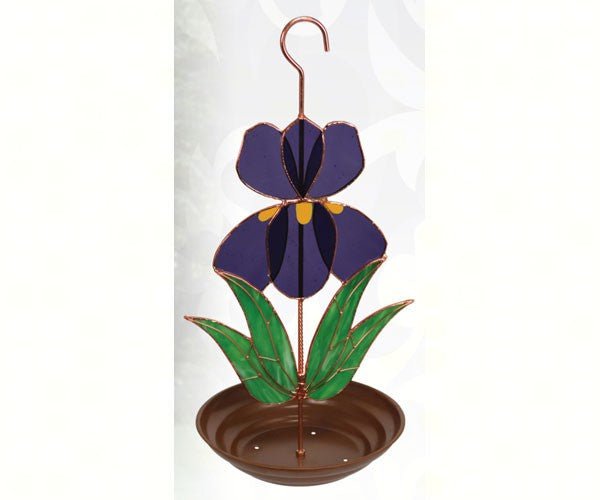
Hanging feeders work best where you want the feeder itself to be part of the garden view. The Purple Iris Hanging Stained Glass Bird Feeder blends cut stained glass with a copper-toned metal pan, lead soldered and electroplated for outdoor use. It measures 21 inches tall by 8 inches in diameter and has drainage holes in the seed pan. The listing describes its colors as not fading, peeling, or scratching off, and notes that it attracts cardinals, chickadees, and titmice.
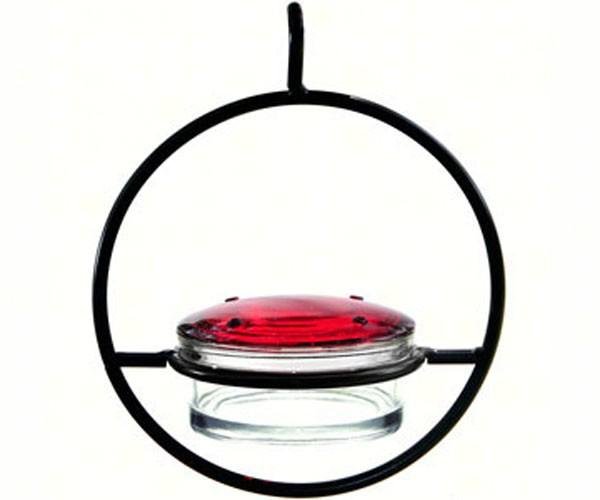
The Cardinal Handcrafted Metal Hanging Bird Feeder is hand-painted metal, powder coated, with a metal roof that shelters birds and keeps seed dry. At 9.5 by 9.5 by 13 inches, it hangs from a tree, shepherd's hook, and similar supports.
Best for: porches and visible garden focal points. Skip if: you need more than a small tray of seed.
Hopper and Combination Feeders in Recycled Poly Lumber
The Gray and Blue Hanging Poly Lumber Combination Hopper and Suet Feeder is built from recycled plastic and milk jugs, guaranteed never to crack, split, or fade, with two suet cages and a patented mesh screen that drains water away from seed. It holds about 3 pounds of seed plus 2 suet cakes.
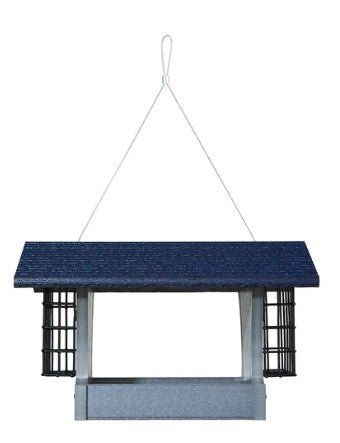
The Two-Toned Double Sided Hopper holds up to 3.3 pounds and feeds birds from both sides, with a removable seed tray and hinged roof for refilling. Its listing specifies aluminum hinges and stainless steel screws.
Best for: year-round feeding with suet in winter. Skip if: you want a decorative centerpiece.
Large-Capacity Gazebo Feeders and Stake Feeders
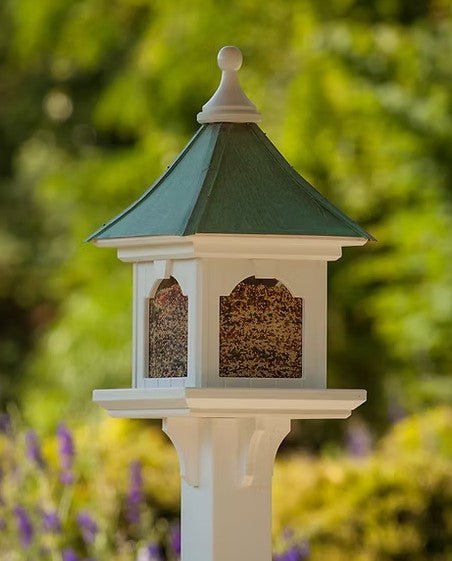
If refilling is your least favorite chore, capacity helps. The Gazebo-Style Large Capacity Post Mounted Bird Feeder is handcrafted in North Carolina from PVC board with a copper or verdigris roof, an 8-pound seed capacity, a removable roof, and a lift-off finial for filling. It ships in 7 to 10 days.
The Sunflower Ceramic Garden Stake set places two 29.5-inch feeders between flower beds, and the galvanized metal birdbath-feeder can be used as a bath, feeder, or planter.
Watch out: a post-mounted feeder uses brackets that fit a 4 x 4 vinyl sleeve post, so plan the location before it arrives.
Best Seeds for Songbirds and Which Feeder Suits Each One
Black oil sunflower seed is a common choice for many songbirds and suits a wide range of feeder types. Cardinals, chickadees, titmice, nuthatches, and finches are commonly reported to eat it.
But the keyword is songbirds, not birds in general, and the useful question is which feeder and food combination brings the species you actually want. Here is a species-by-species match.
Cardinals. Large, heavy-bodied birds that need a stable perch and a wide port. A hopper or tray feeder with a perch rail suits them better than a small tube.
Chickadees and titmice. Acrobatic and comfortable on small perches. A tube feeder with short perches and small ports works, as does a hanging tray. Black oil sunflower and shelled peanuts are the reliable draws.
Finches (house, purple, goldfinch). Small beaks that suit nyjer and thistle. Nyjer needs a fine-port feeder, which is why tube feeders with tiny ports remain the standard for that seed. Goldfinches also take sunflower chips, and a mesh feeder reduces waste.
Nuthatches and woodpeckers. Suet cages and suet logs are the direct match, with black oil sunflower as a backup. Woodpeckers need a feeder they can cling to, so a suet cage mounted on a trunk or a post beats a swinging hopper.
Bluebirds. Mealworms are the reliable draw, offered in a dedicated cup or tray. A bluebird-specific feeder with an optional mealworm cup keeps the worms out of the seed and away from larger birds.
Ground-feeding species (juncos, sparrows, doves). A stake feeder or a low platform serves them. Millet, cracked corn, and sunflower hearts scattered at ground level match how they feed naturally.
Match the seed to the feeder:
- Hopper and tray feeders: mixed seed, black oil sunflower, safflower, cracked corn
- Tube feeders: nyjer and thistle for finches; sunflower chips for small beaks
- Suet cages: suet cakes for woodpeckers and nuthatches
- Stake and ground feeders: mealworms, fruit, peanut chunks, millet
- Bluebird-specific feeders: mealworms in the optional cup
Port size and perch placement matter as much as the seed. A port sized for a chickadee excludes a cardinal; a perch too short for a cardinal's feet keeps it from settling. Our guide to feeders that attract cardinals walks through port size and perch placement in detail.
Watch out: mixing nyjer into a hopper with larger seed wastes it, because the small seed sifts to the bottom and the finches cannot reach it through a wide port.
Squirrel-Proof Bird Feeders: What Actually Works
No feeder is truly squirrel-proof. Squirrel-resistant is the honest term, and it comes down to four defenses working together: a physical barrier, a weight-triggered or spring-loaded closure, a material a squirrel cannot chew through, and placement that removes the launch point.
Placement can matter as much as product features when deterring squirrels. Keeping the feeder well away from fences, roof edges, and low branches reduces the routes squirrels can use to reach it.
Barriers and baffles. A pole baffle stops squirrels climbing from below; a cone or stovepipe baffle on the pole is the standard answer. A hanging baffle above the feeder stops squirrels dropping from a branch.
Weight-triggered closures. These feeders close their ports when a squirrel's weight lands on the perch or the outer ring. They work, but they depend on calibration: a feeder set for a heavy squirrel may also close on a large cardinal, and a feeder set light enough for chickadees may not trip on a small squirrel.
Materials. Recycled poly lumber is a durable material option on this list. The poly lumber feeders are listed as guaranteed never to crack, split, or fade.
Hardware and hanging. A squirrel's weight plus its motion puts load on the hanger, not just the feeder. Use a metal hanger or chain rated well above the feeder's loaded weight, and check the connection point at the roof.
What to expect. Squirrels test new feeders for a week or two, and a baffle that works in July may need adjustment when leaves drop in fall and open a new launch path. Recheck clearance each season.
Watch out: a weight-triggered feeder hung close to a tree gives a squirrel a short, low-energy jump that lets it land and leave before the port closes, so the closure never does its job.
How to Clean a Bird Feeder and Keep Songbirds Healthy
Clean a hanging or hopper feeder every two weeks in warm weather, and monthly in winter. Regular cleaning helps keep feeders hygienic for visiting birds.
- Empty remaining seed into a bag and discard anything damp or clumped.
- Disassemble removable parts: seed trays, roofs, suet cages.
- Scrub with hot soapy water and a bottle brush, paying attention to corners.
- Rinse thoroughly and let every piece dry completely in the sun.
- Refill with fresh seed and rehang.
Stained glass and ceramic pieces need a gentler hand: warm water, mild soap, no abrasives on the glass. Our step-by-step feeder cleaning guide covers the full routine.
Choosing Your Artisan Feeder at In the Garden and More
Pick by where you will hang it and what you want to feed. A shaded porch calls for the stained glass or cardinal metal feeder. A fence line or open lawn calls for the poly hopper or the gazebo post mount. A flower bed calls for the sunflower stakes.
Many of the artisan bird feeders we carry are made in the USA.
Songbird season does not wait, and neither should your feeder. In the Garden and More curates handcrafted, American-made garden décor, backs it with personalized customer service, and helps you choose pieces that last beyond a single winter. Browse the collection, and we will help you match the right feeder to your yard and your birds.
Frequently Asked Questions
What is the best type of bird feeder for attracting songbirds?
Tube and hopper feeders suit the widest range of songbirds because they hold sunflower seed and mixed seed that cardinals, chickadees, titmice, and finches all eat. A tray or platform style, like the Purple Iris stained glass feeder, is one option for hanging feeders. Combination hopper and suet feeders add suet cages for woodpeckers and nuthatches. Matching the feeder type to the birds you want is more reliable than buying one feeder and hoping every species adapts to it.
What seeds should I put in a feeder to attract songbirds?
Black oil sunflower seed is a common choice for many songbirds, including cardinals, chickadees, titmice, and finches. Nyjer (thistle) seed suits goldfinches and siskins in a small-port feeder. Suet cakes bring woodpeckers and nuthatches, especially in cold months. The Sunflower Ceramic Garden Stake Feeders accept cracked corn, fruit, mealworms, mixed seed, peanuts, safflower, suet, sunflower kernels, sunflower seed, and thistle seed, so you can rotate foods by season without buying a second feeder.
Are handmade bird feeders safe for wild birds?
Feeders with drainage holes in the seed tray help keep seed dry, such as the Cardinal Handcrafted Metal Hanging Bird Feeder and the gazebo-style feeders. Regular cleaning and dry storage of seed are good practice for any feeder.
How do I keep squirrels away from a songbird feeder?
Start with a feeder squirrels cannot chew through. Recycled poly lumber feeders, such as the Two-Toned Poly-Lumber Double Sided Hopper, are listed with a guarantee to never crack, split, or fade. Positioning the feeder away from trees and fences, or using a baffle on the pole, can help discourage squirrels.
How often should I clean a bird feeder?
Empty old seed, clean the tray and ports, rinse thoroughly, and let the feeder air dry fully before refilling. Feeders with removable seed trays and removable roofs, like the gazebo-style models, can make cleaning easier.

Leave a comment