
Decorations for Garden: 7 Ideas to Transform Your Yard

Table of Contents
- Garden Statues and Sculptures That Anchor Your Landscape
- Outdoor Lighting and Solar Stakes for Evening Ambiance
- Garden Fencing and Borders That Define Your Space
- Water Features and Fountains for a Calming Focal Point
- Decorative Planters and Pots That Showcase Your Plants
- Wind Spinners and Kinetic Art That Bring Movement
- Wall Decor and Plaques for Vertical Interest
- Handcrafted Outdoor Garden Art: Why It Stands Apart
- Frequently Asked Questions
Last Updated: September 19, 2026
Garden Statues and Sculptures That Anchor Your Landscape
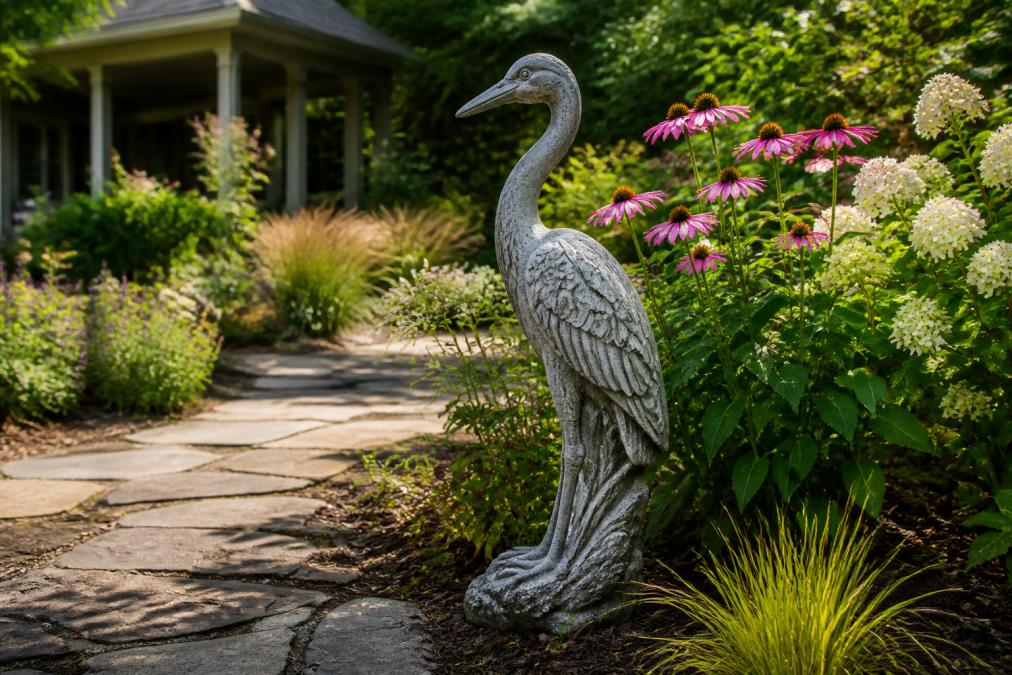
Decorations for garden spaces work best when they start with one strong anchor piece. A statue or sculpture gives the eye somewhere to land, and everything else orbits around it. At In the Garden and More, we offer a curated selection of unique, handcrafted decor to help you transform your home and garden.
The trick most people miss is scale. A statue that looks substantial in a shop can vanish against a mature hedge. Measure the planting bed before you buy, and pick a piece roughly one-third the height of the tallest plant behind it.
Material matters just as much. Cast stone and resin hold up to freeze-thaw cycles better than painted plaster, which crazes after one hard winter. Bronze and iron develop a patina many gardeners prefer, though both need occasional waxing to slow rust.
- Cast stone: heaviest, most weather-resistant, best for permanent placement
- Resin and fiberglass: lighter, easier to move, good for renters
- Metal: bronze, iron, or aluminum, ages gracefully, needs seasonal care
- Concrete: affordable, porous, seal it before winter
Outdoor Lighting and Solar Stakes for Evening Ambiance
Outdoor lighting turns a garden you look at into a garden you sit in. Solar stakes are the easiest entry point: push them into a border, and a photovoltaic panel charges an internal battery through the day, then a photocell switches the LED on at dusk. No wiring, no transformer, no electrician.
The catch is placement and math. A solar stake needs six to eight hours of direct sun to fully charge, and most residential units run three to eight hours on a full charge. A shady bed under a maple will leave them dim by 9 p.m. If your garden is heavily shaded, low-voltage path lights give more consistent results, a 12-volt system runs off a plug-in transformer and buried cable, so output doesn't depend on the weather.
Layer your lighting rather than flooding the space. A common pattern is three tiers:
- Uplights at the base of trees or statues to graze texture upward
- Path lights along walkways at roughly 6 to 8 feet apart for even pools of light
- Decorative stakes tucked into beds for whimsical accents
Warm color temperatures (2700K to 3000K) read as inviting; cooler 4000K and up reads as security lighting and washes out foliage color.
- Solar stakes: no wiring, best in full sun, replaceable batteries typically last one to two seasons before losing capacity
- Path lights: consistent output, need a transformer and buried cable, run day or night on a timer or photocell
- String lights: warm overhead glow for patios and pergolas, look for outdoor-rated wire and shatter-resistant bulbs
- Uplights: dramatic, highlight a focal point like a sculpture, often low-voltage or line-voltage depending on wattage
Keeping Lighting Working Through the Seasons
Solar stakes lose capacity in cold weather because battery chemistry slows down. Low-voltage path lights are more forgiving, but check buried cable for nicks each spring and keep transformer connections above grade in a weatherproof housing.
Garden Fencing and Borders That Define Your Space
Garden fencing and borders do quiet structural work. They separate a vegetable patch from a flower bed, hide utility boxes, and give a yard a sense of rooms. Without them, even beautiful decorations read as clutter.
For a low-maintenance edge, steel or aluminum edging holds a crisp line for years and won't rot like wood. If you want rustic charm, cedar or locust pickets weather to a soft gray. Living borders such as boxwood or lavender take longer to establish but soften hardscaping lines.
Match the border to the job. A knee-high picket fence defines a cottage garden. A taller privacy fence blocks a view. A simple row of stones or bricks is enough to separate a lawn from a planting bed.
Water Features and Fountains for a Calming Focal Point
Water features add sound, motion, and a natural gathering point. A small fountain or bubbling rock transforms a patio's ambiance, and the moving water helps mask traffic noise.
Decorative Planters and Pots That Showcase Your Plants
Decorative planters are the most flexible decorations for garden use, because you can move them, regroup them, and swap plantings by season. A matched pair flanking a doorway frames an entrance, and a single oversized pot can stand in for a shrub where you have no ground to plant.
Choose the pot for the plant's needs, the yard's look, and your climate. Material drives how often you water, whether the pot survives winter, and how heavy it is to move.
- Terracotta: breathable, so soil dries faster and roots get air; classic warm look; cracks in hard freezes unless emptied and stored
- Glazed ceramic: holds moisture longer, comes in saturated colors, heavier than terracotta, and the glaze can craze or chip if water gets in and freezes
- Resin: lightweight, weather-resistant, good for balconies and decks where weight matters; UV-stabilized resin resists fading, cheaper resin chalks in strong sun
- Fiberstone (fiberglass-reinforced concrete): looks like cast stone at a fraction of the weight, holds up to freeze-thaw better than unsealed concrete
- Concrete: affordable and stable, but porous, seal it before winter or it absorbs water and spalls
Drainage is non-negotiable. A pot with no drainage hole turns into a swamp and rots roots. If you love a cachepot with no hole, plant in a nursery pot inside it and empty the reservoir after watering. A saucer is fine, but don't let the pot sit in standing water.
Sizing, Soil, and Watering by Material
Use a potting mix, not garden soil, in containers. Garden soil compacts in a pot and drains poorly. A mix with perlite or bark keeps air around the roots.
Winter Care and Climate Durability
Climate shifts the recommendation. In humid regions, choose glazed or resin pots over unsealed concrete, which stays damp and grows algae. In desert sun, UV-stabilized resin and glazed ceramic resist fading better than painted finishes. In cold-winter areas, fiberstone and resin survive freeze-thaw with the least fuss.
Wind Spinners and Kinetic Art That Bring Movement
Wind spinners and kinetic sculpture give a garden life even when nothing is blooming. A spinner catches the breeze and turns a still corner into a focal point, drawing the eye the way a statue does.
Metal spinners in stainless steel or powder-coated aluminum hold up best outdoors. Cheaper painted versions fade and rust within a season or two. Hang or stake them where they catch prevailing wind, not in a sheltered nook.
Balance is the design rule. One large spinner makes a statement; a cluster of small ones can look busy. Pair kinetic pieces with quieter decorations so the movement stands out rather than competes.
Wall Decor and Plaques for Vertical Interest
Wall decor and plaques solve a problem fences and bare walls create: too much flat surface. A metal garden sign, carved plaque, or trellis-mounted ornament breaks up the plane and adds vertical interest where you have no ground to plant.
This is where small-space gardening wins. On a balcony or a narrow patio, the wall is often the largest surface you have. A vertical planter, a decorative plaque, or a mounted bird feeder turns that wall into a feature instead of a blank backdrop.
Weather-resistant materials matter here more than anywhere, since these pieces take full sun and rain. Powder-coated metal, sealed wood, and stone hold up. Unsealed softwood and thin sheet metal don't.
Handcrafted Outdoor Garden Art: Why It Stands Apart
Handcrafted outdoor garden art is made by individual artisans rather than on a factory line, so each piece carries small variations in finish, texture, and form. That irregularity is the point. A hand-thrown planter or hand-forged spinner has a character a mass-produced copy can't match.
Durability is the honest question buyers ask.
| Decoration Type | Best Material | Maintenance Level | Best For |
|---|---|---|---|
| Statues and sculptures | Cast stone, bronze | Low | Anchoring a focal point |
| Solar stakes and lighting | Powder-coated metal, glass | Low | Evening ambiance |
| Fencing and borders | Aluminum, cedar | Low to medium | Defining spaces |
| Water features | Resin, cast stone | High | Calming focal point |
| Planters and pots | Terracotta, fiberstone | Medium | Showcasing plants |
| Wind spinners | Stainless steel | Low | Adding movement |
| Wall decor and plaques | Powder-coated metal | Low | Vertical interest |
| Handcrafted art | Varies by maker | Varies | One-of-a-kind character |
Frequently Asked Questions
What garden decorations are trending now?
Handcrafted pieces with natural materials are seeing strong interest, including ceramic bird feeders, metal kinetic sculptures, and upcycled garden art. Solar-powered lighting and decorative stakes remain popular for adding evening ambiance without wiring. Homeowners are also gravitating toward weather-resistant sculptures and planters that double as focal points. The shift favors unique, artisan-made items over mass-produced plastic decor, with many buyers prioritizing pieces that develop character over time through natural weathering.
How do I choose durable outdoor decor for my climate?
Match materials to your local conditions. Check that paints and finishes are rated for exterior use. Rotate lightweight items indoors during extreme weather to extend their life.
Leave a comment