
How to Choose a Garden Arbor: Sizing, Style, and Material

Last Updated: November 24, 2026
Quick Summary
To choose the right garden arbor, measure your walkway first, then pick a material that suits your climate, match the style to your garden, and plan the installation. Size the opening at least 6 inches wider than the walkway on each side, with 80 inches of headroom.
- Measure the walkway at its narrowest point, not its widest, before shopping.
- Order by opening width, not overall width, to avoid the most common sizing error.
- A single walker needs about 36 inches of clear opening; two people need closer to 60.
- If you won't seal annually, choose vinyl or powder-coated metal over wood.
- Call 811 before digging to have underground utility lines marked.
Table of Contents
- How do you choose the right garden arbor for your yard?
- Garden Arbor Size Guide: Measuring Walkway Width, Opening, and Clearance
- The Best Material for a Garden Arbor: Wood, Metal, or Vinyl
- Matching Arbor Style, Shape, and Height to Your Garden Design
- Choosing a Garden Arbor for Climbing Plants and Long-Term Load
- Garden Arbor Installation: Anchoring, Permits, and Utilities
- Pick Your Arbor and Plan the Entrance
- Frequently Asked Questions
How do you choose the right garden arbor for your yard?
Choosing the right garden arbor comes down to four decisions made in order: measure your space, pick a material that suits your climate, match the style to your garden, then plan the installation. Get those right and the structure will look intentional rather than dropped in.
Many homeowners buy an arbor before measuring the path it was meant to frame. The fix is unglamorous: start with a tape measure, not a catalog.
Below, we'll walk through a measurement worksheet, the real trade-offs between wood, metal, and vinyl, and the installation details most guides skip. One note: a garden arbor is a freestanding or anchored frame with two side panels and an open top, built to mark an entrance or frame a view.
Start with your yard layout and available space
Walk your yard before you shop and answer three questions: where does the path naturally lead, how much room is actually free, and what will the arbor block?
- Put the arbor where a path already exists or where you want to create one. Forcing a walkway to fit an arbor looks wrong from every angle.
- Leave at least 18 inches of clearance on each side for plants, and more if you plan to grow anything vigorous.
- Keep the structure away from downspouts, gutter lines, and low roof overhangs.
- Check sightlines from your kitchen window or patio. The arbor should frame something, not hide it.
A common mistake is placing an arbor at the property line where it becomes a fence substitute. Put it where it belongs: at a threshold between two zones of the garden.
Garden Arbor Size Guide: Measuring Walkway Width, Opening, and Clearance
Step 1: Measure the walkway width. Pull a tape across the path at the narrowest point, not the widest.
Step 2: Measure the opening, not the footprint. The opening width is the clear distance between the inside faces of the posts.
Step 3: Check walk-through clearance. A single person walking comfortably needs roughly 36 inches of clear opening. Two people passing side by side need closer to 60 inches.
Step 4: Check headroom. Measure the clear height under the top beam. Most adults want at least 80 inches to walk through without ducking, and taller visitors will want more.
Step 5: Check overall height against context. An arbor that towers over a 4-foot picket fence looks out of scale. One that disappears behind a hedge does nothing.
A simple measurement worksheet
Copy this into your phone notes and fill it in before you shop:
| Measurement | How to take it | Your number |
|---|---|---|
| Walkway width at narrowest point | Tape across the path | ______ in |
| Desired clear opening | Walkway + 6 in each side | ______ in |
| Clear headroom needed | Tallest regular visitor + 4 in | ______ in |
| Overall height allowed | Compare to fence and hedge height | ______ in |
| Side clearance for plants | 18 in minimum each side | ______ in |
| Available depth | Front to back of intended spot | ______ in |
Watch out: ordering from the overall width instead of the opening width is the single most common sizing error. A 50-inch opening fits a 48-inch path comfortably; a 50-inch overall width does not.
The Best Material for a Garden Arbor: Wood, Metal, or Vinyl
There is no single best material for a garden arbor. The right choice depends on your climate, how much upkeep you will actually do, and how long you expect the structure to last.
Wood wins on warmth and character. Cedar and redwood are commonly chosen for outdoor structures, and both weather to a soft gray if you let them.
Metal brings slender profiles and strength. Wrought iron and powder-coated steel hold climbing plants well and last decades, but they rust where the coating chips and get hot in direct summer sun.
Vinyl is the low-maintenance choice. Premium weather-resistant vinyl does not rot, warp, or need repainting, and it cleans with a garden hose. It holds up through freeze-thaw cycles and coastal humidity because it does not absorb water.
Match the material to your climate and maintenance reality
| Material | Maintenance cadence | Weather resistance | Expected lifespan | Repair approach | Best for |
|---|---|---|---|---|---|
| Cedar / redwood | Seal every 1-2 years; inspect joints after winter | Good; ages to gray; rot risk at ground contact | Long with upkeep | Replace boards and joints | Natural, rustic gardens; cold climates with maintenance |
| Bamboo | Moderate; inspect for splitting | Fair in cold climates | Shorter than cedar | Replace sections | Mild-climate, tropical looks |
| Iron / steel | Touch up chips annually; check welds in coastal air | Excellent; rusts at chips and scratches | Decades | Touch-up paint; fabricator for bends | Formal gardens, heavy vines, windy sites |
| Vinyl | Rinse with a hose; tighten hardware seasonally | Excellent; no rot or water absorption | Long; warranty-dependent | Replace cracked panels | Busy homeowners, coastal yards, freeze-thaw climates |
A practical rule: if you will not commit to annual sealing, choose vinyl or powder-coated metal. If you want the structure to age with the garden and you enjoy seasonal upkeep, cedar or redwood rewards that attention. If wind is your dominant condition, metal's strength helps, but only if it is anchored properly.
If you want to see how a metal frame with a gate looks in practice, browse a brushed bronze metal arch topped garden arbor with gate. If low maintenance is the priority, a Vienna garden white vinyl arbor shows what vinyl looks like before you commit.
Matching Arbor Style, Shape, and Height to Your Garden Design
Style should follow the garden, not the other way around. A cottage garden with picket fencing and loose perennials suits a flat-top arbor with lattice panels and a picket gate. A formal garden with clipped hedges and straight lines suits an arched or swooped design with clean posts.
Shape matters more than most buyers expect. Flat-top arbors read as architectural and modern. Arched tops soften the line and suit traditional plantings. Lattice side panels give vines something to grab; open sides keep the view clear.
Height should relate to what stands beside it. A good rule of thumb is to keep the arbor within a foot or two of your fence height, or clearly taller if you want it to be a focal point. Anything in between looks accidental.
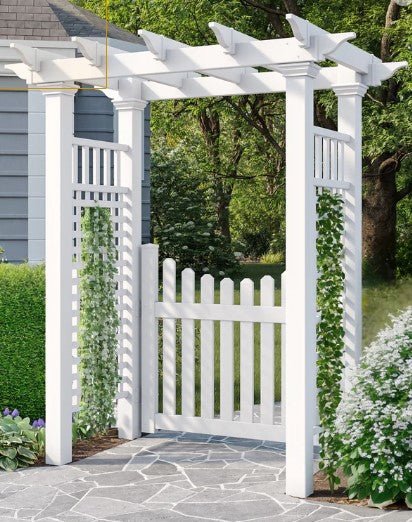
For a specific arched vinyl design with full dimensions, you can view a pristine white vinyl Windsor arbor made in the USA. If a cottage entrance is the look you want, a pristine white Fairfield garden arbor with cottage picket gate pairs an 86.5-inch height with a 50-inch opening and a 20-year warranty against manufacturing defects.
Choosing a Garden Arbor for Climbing Plants and Long-Term Load
A garden arbor for climbing plants needs a structure rated to carry weight, and a planting plan that accounts for how big the vine gets in five years, not one.
- Clematis suits lattice panels and a sunny face with shaded roots.
- Climbing roses need sturdy posts and horizontal rails to tie canes to.
- Wisteria is the heavy one. It needs a genuinely rigid structure and annual pruning, or it will pull joints apart.
- Morning glory and sweet pea are light and fast, ideal for a first season of coverage.
Plant at least 12 inches from the post base so roots and irrigation don't undermine the anchor. Then train, don't wrap: guide new growth horizontally along the lattice rather than spiraling it up a post, which produces flowers at the top and bare stems below.
What most guides miss is the load question. A mature vine holds rain and snow, and that weight lands on the top rails. Vinyl and iron handle it well; light wood joints need a hardware check each spring.
Garden Arbor Installation: Anchoring, Permits, and Utilities
Anchoring is one of the most important parts of installation. A tall, open frame catches wind from every direction, and an unanchored arbor becomes a projectile.
Ground conditions come first. Note whether the spot is soil, gravel, or existing hardscape. Soil that stays wet, heavy clay, and sandy loam all behave differently under a post.
Choose the anchoring method to match the ground.
- Soil installation: set posts in gravel footings or on metal anchors driven below grade, then backfill and compact. Ground stakes and anchors rated for the structure are the minimum; a tall arbor in an exposed site benefits from concrete footings.
- Hardscape installation: use surface-mount brackets bolted into the patio or path with masonry anchors. Check that the frame is plumb before you tighten anything, and re-check after the first season.
- Wind exposure: a freestanding arbor on an open lot needs more than a sheltered courtyard arbor. If your site takes steady wind, plan for deeper footings or additional bracing rather than relying on the frame alone.
Before you dig, call 811, the national call-before-you-dig service, to have underground utility lines marked.
Permits depend on your local jurisdiction. Many areas exempt small garden structures, but height, footprint, and setback rules vary by municipality, so confirm with your local building department before installation.
Watch out: a gate hung on a post that isn't anchored will sag within a season. Anchor first, hang second, and confirm the posts are plumb and the opening is square before adding any gate hardware.
Pick Your Arbor and Plan the Entrance
Start with the worksheet, not the wishlist. Measure the path, decide the material based on how much maintenance you actually want, then choose a style that matches what already stands in the yard. That order turns a decorative purchase into a decision you won't second-guess.
If you're placing an arbor as part of a larger refresh, it helps to plan the whole picture at once. Our guide to a cohesive garden aesthetic walks through tying structures, plantings, and accents into one unified outdoor space.
The hardest part of this project isn't assembly. It's committing to a measurement and a material before you fall for a photo.
Frequently Asked Questions
How tall should a garden arbor be?
Most walk-through garden arbors stand 84 to 92 inches tall, which gives roughly 80 inches of headroom under the arch. That clears most adults comfortably. If you plan a bench or seating area beneath it, look for a model at the taller end of that range. The Pristine White Florence Garden Arbor, for example, stands 88 inches overall.
Which material is best for a garden arbor?
It depends on your climate and how much upkeep you want. Wood such as cedar or redwood looks warm and ages naturally but needs periodic sealing or staining. Metal is strong and slim but can rust in coastal or humid areas unless powder-coated. Vinyl costs more up front yet needs no painting and resists rot, which is why brands back it with long warranties like the 20-year coverage on In the Garden and More's vinyl arbors.
How do you secure a garden arbor in the ground?
Most vinyl and metal arbors ship with ground stakes or anchors that drive into soil or gravel. Set the legs at least 12 to 18 inches deep, tamp the soil firmly, and check for level before tightening hardware. On windy sites or in loose sandy soil, add concrete footings. Before digging, call 811 to have underground utility lines marked, and check local rules on whether a freestanding structure needs a permit.
What plants grow well on a garden arbor?
Choose climbers that match your light and climate. Clematis, climbing roses, wisteria, honeysuckle, and annual morning glory are common picks. Match the plant's mature weight to the structure: heavy wisteria needs a sturdy frame, while lightweight vines suit lattice panels. Plant at the base, train shoots early, and leave room for the arbor to carry the load as the plant fills out over several seasons.

Leave a comment